一般・学生向け
低温研で活躍する学生
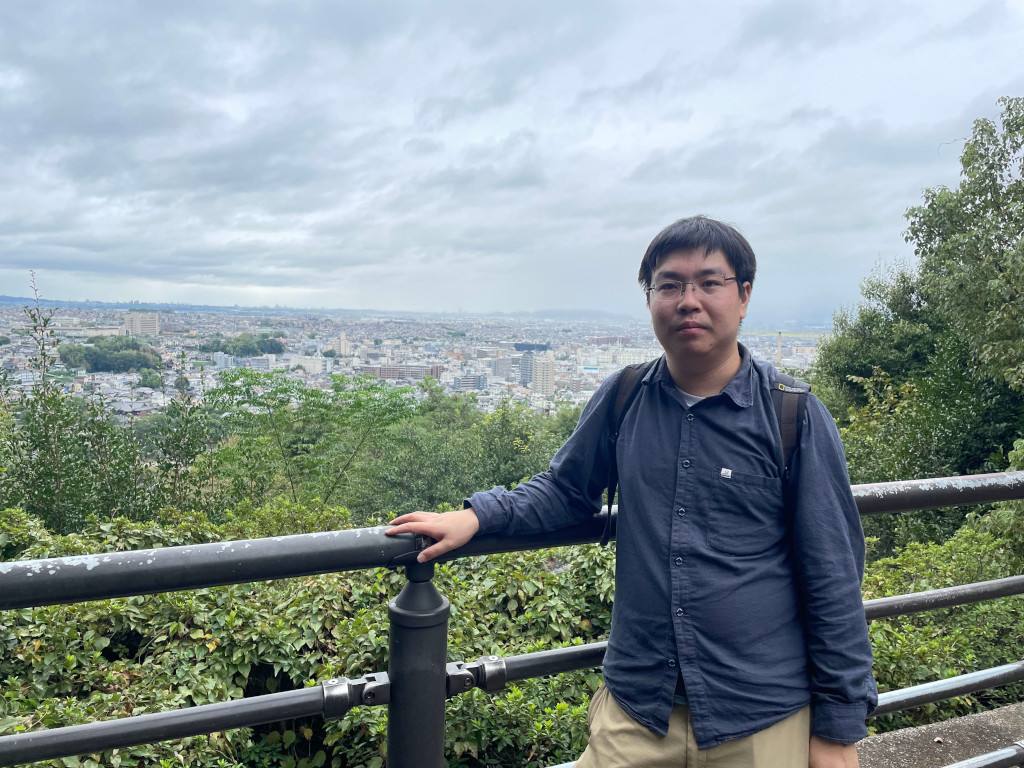
Zhao Yuheng
相転移ダイナミクス分野/理学院 宇宙理学専攻 D1
写真:On the 大吉山展望台.
How did you come to know about ILTS?
I learned about ILTS during the COVID-19 period, when I was applying to graduate school and hoped to continue my research on the water-ice phase transition in Peking University. The name of Low Temperature Science attracts me attention. After learning more about ILTS, I understood that it is a comprehensive institute dedicated to research in low-temperature science. It includes not only laboratories devoted to ice and snow research, but also a wide range of laboratories in fields such as biology, chemistry, and geology.
What kind of research are you currently doing at ILTS?
I study the growth kinetics of ice crystals under different ambient environments. To do this, I use an advanced optical microscopy system (LCM-DIM), designed by Professor Gen Sazaki, which is capable of achieving sub-nanometer resolution along z direction. We directly observe the single molecule level structures on ice crystal surfaces under different ambient environments. I measured the velocities of elementary steps and calculated the step kinetics coefficients under different ambient nitrogen gas pressures. We found that the surface kinetics are significantly suppressed with increasing ambient nitrogen gas pressure. To fully understand the molecular-level suppression mechanism, I am also investigating the behavior of the quasi-liquid layer (a metastable liquid phase on the ice crystal surface) under different ambient nitrogen gas pressures. Moreover, by conducting molecular dynamics simulations, I am examining the roughening of water and silicon crystal surfaces under various conditions.
What is the reason why you decided to enter graduate school?
The first reason is that I have a strong interest in research. I have long been interested by physical and chemical phenomena in everyday life, and as my studies progressed, the recent advances in both theoretical and experimental research have greatly inspired me and motivated me to continue research work. Another reason is my desire to contribute to the advancement of human knowledge. Graduate study provides the opportunity to work at the forefront of a specialized field, something that ordinary careers rarely offer. I now feel greatly rewarded to be helping expand our understanding of the water-ice phase transition.
How did you choose your current laboratory?
Because of the COVID-19 pandemic, I worked in my previous laboratory as a research assistant for three years. There, I focused on investigating ice nucleation and the structure of supercooled water using molecular dynamics simulations. I felt that if these findings could be confirmed experimentally, the results would become much more solid and convincing. My current laboratory is at the forefront of developing and applying optical microscopy systems for in-situ observation of the water-ice phase transition and has produced several remarkable achievements. In my current laboratory, I can continue my research on the water-ice phase transition while also gaining valuable experience in conducting high-quality experimental work.
Furthermore, I chose my current laboratory because of its excellent academic atmosphere. Professor Gen Sazaki is very friendly and patient, and he kindly supported me both academically and in adapting to life in Japan when I just arrived. The other two faculty members in my laboratory, Dr. Ken Nagashima and Dr. Ken-ichiro Murata, have also been very warm and supportive, always helping me whenever I encountered difficulties. This warm and friendly environment is another important reason why I decided to join this laboratory.
How do you spend your holidays?
I am very interested in Japan’s traditional culture and its railway system. So, I sometimes travel to other cities in Japan and enjoy taking trains during my days off. I have visited Kyoto several times, and those experiences have left me with many treasured memories. I have also traveled by train, such as taking the train to Wakkanai and Hakodate for sightseeing and I also took the train from Sapporo to Tokyo. However, on most of my days off, I usually prefer to rest at home. Recently, I have also started running along the roads around our university to keep fit.
How is life in Sapporo?
Life in Sapporo feels very new and unique to me. The summers are pleasantly cool, while the winters are extremely snowy, creating one of the most distinctive climates in the world. During winter, the Snow Festival left a deep impression on me. Sapporo is the largest city in Hokkaido, where you can easily find shopping malls, restaurants, and tourist attractions, making life very convenient. Delicious and affordable agricultural and seafood products, friendly people, and a pleasant living environment provide me with a very comfortable life in Sapporo.
What advice would you give to younger students who want to enter graduate school?
Just by my previous experience, the life of a Ph.D. candidate is not extremely difficult, but it is certainly not easy either. Experiencing failure during research is very common, although it can be challenging for students to handle. At the same time, it is important to remember that every researcher has faced or will face similar difficulties. During such challenging periods, a strong interest in research and a positive mindset can provide great support. Therefore, in my personal opinion, I think it is important to be well prepared both academically and mentally before entering graduate school.
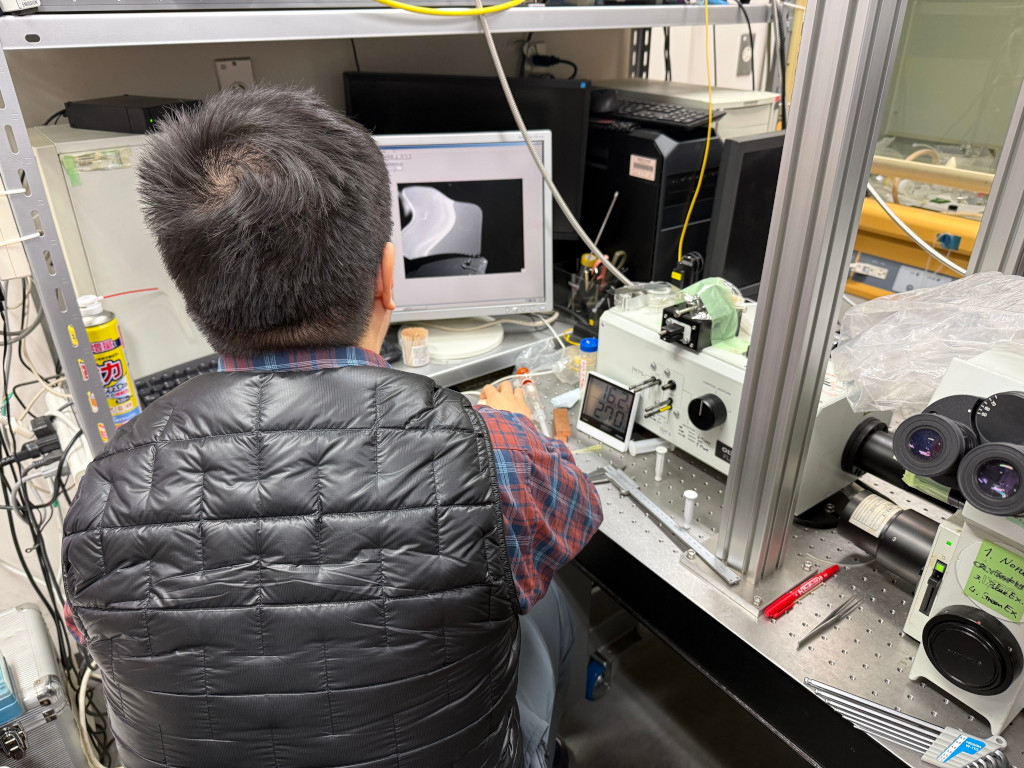
写真:Operating a LCM-DIM to observe the elementary steps on an ice crystal surface.
(2026.2)